| | CLEVELAND, September 15 -- Brother G.Y. Bailey, Local Chairman of BLET Division 62 in Houston, was killed last night when his train collided head-on with a southbound chemical train in dark territory about 60 miles northeast of Houston. Thursday, September 15, 2005 http://www.ble.org/pr/news/newsflash.asp?id=4177 © 2005 Brotherhood of Locomotive Engineers and Trainmen |
Friday, September 16, 2005
In the Line of Duty: G.Y. Bailey


Sunday, August 28, 2005
BLET members reject Division size initiative
| |
Friday, August 26, 2005 http://www.ble.org/pr/news/newsflash.asp?id=4167 © 2005 Brotherhood of Locomotive Engineers and Trainmen |
Sunday, August 14, 2005
The first two locomotives in Union Pacific's Heritage series were displayed recently in Omaha.
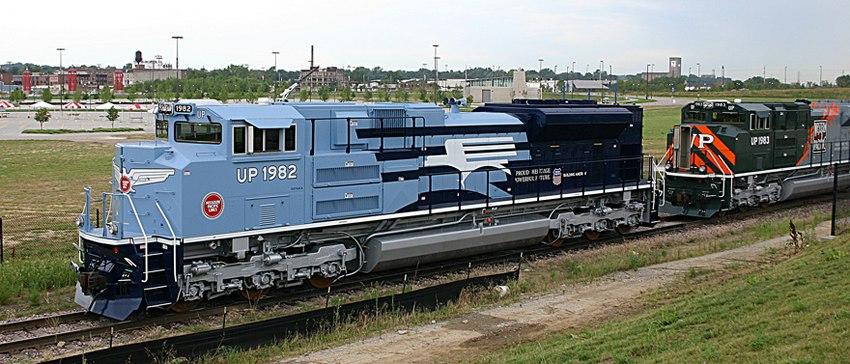
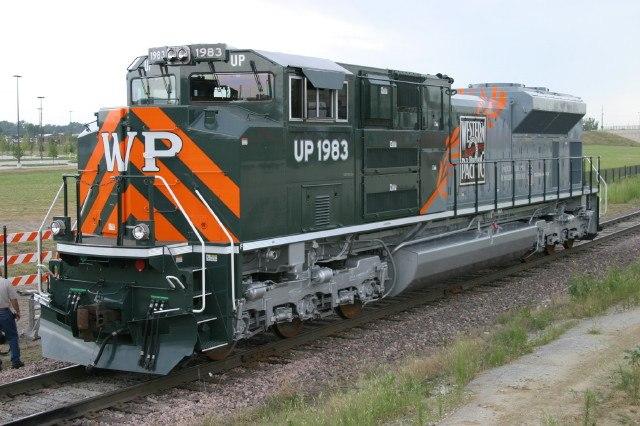
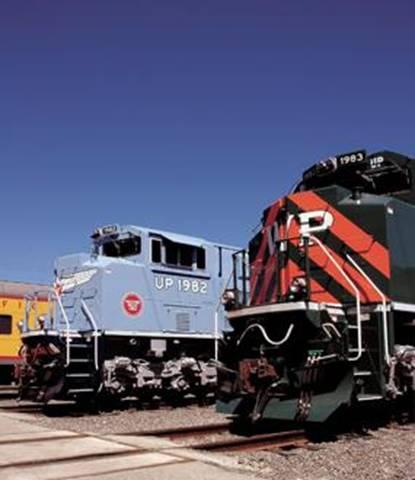
Union Pacific has a new series of locomotives painted to recall the railroads that have merged into the UP.
"Our reputation as America's greatest railroad has been strengthened by the many lines that have become a part of the UP.," said Chairman Dick Davidson. "It is time we pay homage to those railroads and the generations of men and women who helped to build a great nation and the foundation for our future."The first two locomotives in the series were displayed recently in Omaha. Painted to recollect the Missouri Pacific and Western Pacific railroads, the locomotives will operate across the UP system, the railroad said.The Missouri Pacific and Western Pacific locomotives will be followed in coming months by locomotives painted in the style of the Missouri-Kansas-Texas (Katy), Chicago & North Western, Southern Pacific, and Denver & Rio Grande.
The addition of Missouri Pacific more than doubled Union Pacific's route miles, Western Pacific track led UP to the Ports of San Francisco and Oakland, Katy gave UP access to Texas through Oklahoma, Chicago & North Western brought UP to the Windy City, and Southern Pacific and Denver & Rio Grande Western provided the famous Sunset Route and a direct route through Colorado.UP said its Heritage Series marks the fifth time in company history thatthe railroad has painted locomotives in colors other than the traditional "Armour Yellow" paint scheme.Locomotives were custom made in 1991 to honor UP employees serving in the Persian Gulf War, in 1994 to call attention to the United Way Campaign, in 1996 for the Atlanta Games Olympic Torch Relay Train, and in 2002 for the Salt Lake City Games Olympic Torch Relay Train
Saturday, August 13, 2005
President Hoffa's Message to All BLET and BMWE Members - Change to Win Coalition
To read a PDF version of President Hoffa’s message to all BLET and BMWE members regarding the AFL-CIO disaffiliation and the creation of the Change to Win Coalition Click HERE.
Thursday, August 11, 2005
Clarifying UTU smoke and mirrors
| |
Tuesday, August 09, 2005 http://www.ble.org/pr/news/newsflash.asp?id=4164 © 2005 Brotherhood of Locomotive Engineers and Trainmen |
--
Posted by BLETSR to Brotherhood of Locomotive Engineers and Trainmen UPSR News at 8/11/2005 10:42:14 PM
Tuesday, August 09, 2005
DEADLINE FOR APPLICATOIN TO THE JAMES R HOFFA MEMORIAL SCHOLARSHIP FUND IS SEPTEMBER 30, 2005
James R. Hoffa became a Teamster member in 1934, served as General President for 14 years, and, in recognition of his tireless service to the
The James R. Hoffa Memorial Scholarship Fund Essay Contest will award scholarships annually to 50 students. All applicants must comply with the following eligibility criteria.
Each applicant must:
1. Be the son, daughter or grandchild of an eligible Teamster member
2. Be enrolled full-time in an undergraduate college, university or community college program, or a technical orvocational program;
3. Be 23 years old or younger by September 30, 2005; and
4. Not be a former winner of an award from the James R. Hoffa Memorial Scholarship Fund.
The applicant’s Teamster parent / grandparent must be able to demonstrate that
1. He/she was a member in good standing for (i) 12 consecutive months prior to the application deadline; or (ii) 12 consecutive months preceding the member’s retirement / disability / death or (iii) 12 consecutive months prior to the member’s layoff (layoff date must be no earlier than three years prior to the application deadline); or (tv) a period of less than 12 consecutive months prior to the application deadline, together with 12 consecutive months of good standing during some other previous period; and
2. He/she was not a Teamster officer or employee during the relevant period of good standing listed above.
APPLICATION PROCEDURE:
1. Applicant and Teamster parent or grandparent must complete questions 1-12.
2. Applicant must attach, on a separate sheet, a type-written essay of 500 words or less. (Essay will not be returned.)
3. Applicant must forward the completed application and essay to the James R. Roth Memorial Scholarship Fund office by September 30, 2005. We cannot allow any extensions to this deadline.
2005 ESSAY TOPIC:
Describe a brief history of your Teamster parents’ or grandparents’ involvement in their Local Union. How has it affected your family and why it is important to you?
To view a PDF copy of this information click HERE.
To download a copy of the application right click HERE and select save target as.
Monday, August 08, 2005
RAILROAD RETIREMENT AGE REDUCTIONS
August 2005
Railroad retirement benefits are subject to reduction if an employee with less than 30 years of service retires before attaining full retirement age.
Employees with less than 30 years of service may still retire at age 62.
However, the age at which full retirement benefits are payable was increased by 1983 social security legislation first effective in the year 2000. This legislation affected railroad retirement benefits through coordinating provisions of the Railroad Retirement Act, and the age requirements for some unreduced railroad retirement benefits changed just like the social security requirements.
The following questions and answers explain how these early retirement age reductions are applied to railroad retirement annuities.
1. What is the full retirement age for employees with less than 30 years of service and is it the same for all employees?
Full retirement age, the earliest age at which a person can begin receiving railroad retirement or social security benefits without any reduction for early retirement, ranges from age 65 for those born before 1938 to age 67 for those born in 1960 or later, the same as for social security.
2. How are the changes in the maximum age reduction being phased in?
Since 2000, the age requirements for some unreduced railroad retirement benefits have been rising just like the social security requirements. For employees with less than 30 years of service and their spouses, full retirement age increases from 65 to 66, and from 66 to 67, at the rate of two months per year over two separate six-year periods. This also affects how reduced benefits are computed for early retirement.
The gradual increase in full retirement age from age 65 to age 66 affects those people who were born in the years 1938 through 1942. The full retirement age will remain age 66 for people born in the years 1943 through 1954. The gradual increase in full retirement age from age 66 to age 67 affects those who were born in the years 1955 through 1959. For people who were born in 1960 or later the full retirement age will be age 67.
3. How does this affect the early retirement age reductions applied to the annuities of those who retire before full retirement age?
The early retirement annuity reductions applied to annuities awarded before full retirement age are increasing. For employees retiring between age 62 and full retirement age with less than 30 years of service, the maximum reduction will be 30 percent by the year 2022. Under prior law, the maximum reduction was 20 percent.
Age reductions are applied separately to the tier I and tier II components of an annuity. The tier I reduction is 1/180 for each of the first 36 months the employee is under full retirement age when his or her annuity begins and 1/240 for each additional month. This will result in a gradual increase in the reduction at age 62 to 30 percent for an employee once the age 67 retirement age is in effect.
These same reductions apply to the tier II component of the annuity.
However, if an employee had any creditable railroad service before August 12, 1983, the retirement age for tier II purposes will remain 65, and the tier II benefit will not be reduced beyond 20 percent.
The following shows how the gradual increase in full retirement age will affect employees.
Employee Retires with Less than 30 Years of Service
--If the employee was born in 1937* or earlier, his or her full retirement age is 65 and the maximum annuity reduction at age 62 is 20%.
--If the employee was born in 1938*, his or her full retirement age is 65 years and 2 months and the maximum annuity reduction at age 62 is 20.833%.
--If the employee was born in 1939*, his or her full retirement age is 65 and 4 months and the maximum annuity reduction at age 62 is 21.667%.
--If the employee was born in 1940*, his or her full retirement age is 65 and 6 months and the maximum annuity reduction at age 62 is 22.50%.
--If the employee was born in 1941*, his or her full retirement age is 65 and 8 months and the maximum annuity reduction at age 62 is 23.333%.
--If the employee was born in 1942*, his or her full retirement age is 65 and 10 months and the maximum annuity reduction at age 62 is 24.167%.
--If the employee was born in 1943 through 1954*, his or her full retirement age is 66 and the maximum annuity reduction at age 62 is 25%.
--If the employee was born in 1955*, his or her full retirement age is 66 and 2 months and the maximum annuity reduction at age 62 is 25.833%.
--If the employee was born in 1956*, his or her full retirement age is 66 and 4 months and the maximum annuity reduction at age 62 is 26.667%.
--If the employee was born in 1957*, his or her full retirement age is 66 and 6 months and the maximum annuity reduction at age 62 is 27.50%.
--If the employee was born in 1958*, his or her full retirement age is 66 and 8 months and the maximum annuity reduction at age 62 is 28.333%.
--If the employee was born in 1959*, his or her full retirement age is 66 and 10 months and the maximum annuity reduction at age 62 is 29.167%.
--If the employee was born in 1960* or later, his or her full retirement age is 67 and the maximum annuity reduction at age 62 is 30%.
__________
*A person attains a given age the day before his or her birthday.
Consequently, someone born on January 1 is considered to have been born on December 31 of the previous year.
Take the example of an employee born on June 2, 1950, who retires in 2012 at the age of 62. In terms of today's dollars and current benefit levels, not counting future increases in creditable earnings, assume this employee is eligible for monthly tier I and tier II benefits, before age reductions, of $1,200 and $800, respectively, for a total monthly benefit of $2,000.
Upon retirement at age 62, the employee's tier I benefit would be reduced by 25 percent, the maximum age reduction applicable in 2012. This would yield a tier I monthly benefit of $900; the employee's tier II benefit would also be reduced by 25 percent, providing a tier II amount of $600 and a total monthly rate of $1,500. However, if the employee had any rail service before August 12, 1983, the tier II benefit would be subject to a maximum reduction of only 20 percent, providing a tier II amount of $640, and a total monthly rate of $1,540.
As a second example, take an employee born on June 2, 1960, and also eligible for monthly tier I and tier II benefits, before age reductions, of $1,200 and $800, respectively, for a total monthly benefit of $2,000. This employee retires in 2022 at age 62 with no service before August 12, 1983.
Consequently, a 30 percent reduction is applied to both the tier I and tier II benefits and the net total annuity would be $1,400.
5. How are railroad retirement spouse benefits affected by this change?
If an employee retiring with less than 30 years of service is age 62, the employee's spouse is also eligible for an annuity the first full month the spouse is age 62. Early retirement reductions are applied to the spouse annuity if the spouse retires prior to full retirement age. Beginning in the year 2000, full retirement age for a spouse gradually began to rise to age 67, just as for an employee, depending on the year of birth. While reduced spouse benefits are still payable at age 62, the maximum reduction will be 35 percent by the year 2022. However, if an employee had any creditable rail service prior to August 12, 1983, the increased age reduction is applied only to the spouse's tier I benefit.
Take for an example the spouse of a railroader with less than 30 years of service, none of it prior to August 12, 1983, retiring in 2022 at age 62, with a spouse annuity, in terms of today's dollars and current benefit payments and before any reductions for age, of $1,000 a month. With the maximum reduction of 35 percent applicable in 2022, her net monthly benefit would be $650, while if this same spouse were retiring in 2005 at age 62 with the maximum age reduction of 30 percent, her net monthly benefit would be $700.
The following shows how this will affect the spouses of railroad employees if the employee retires with less than 30 years of service.
Spouse Age Reductions
--If the employee retires with less than 30 years of service and the employee's spouse was born in 1937* or earlier, the spouse's full retirement age is 65 and the spouse's maximum annuity reduction at age 62 is 25%.
--If the spouse was born in 1938*, the spouse's full retirement age is 65 years and 2 months and the spouse's maximum annuity reduction at age 62 is 25.833%.
--If the spouse was born in 1939*, her or his full retirement age is 65 and
4 months and the maximum annuity reduction at age 62 is 26.667%.
--If the spouse was born in 1940*, her or his full retirement age is 65 and
6 months and the maximum annuity reduction at age 62 is 27.50%.
--If the spouse was born in 1941*, her or his full retirement age is 65 and
8 months and the maximum annuity reduction at age 62 is 28.333%.
--If the spouse was born in 1942*, her or his full retirement age is 65 and 10 months and the maximum annuity reduction at age 62 is 29.167%.
--If the spouse was born in 1943 through 1954*, her or his full retirement age is 66 and the maximum annuity reduction at age 62 is 30%.
--If the spouse was born in 1955*, her or his full retirement age is 66 and
2 months and the maximum annuity reduction at age 62 is 30.833%.
--If the spouse was born in 1956*, her or his full retirement age is 66 and
4 months and the maximum annuity reduction at age 62 is 31.667%.
--If the spouse was born in 1957*, her or his full retirement age is 66 and
6 months and the maximum annuity reduction at age 62 is 32.50%.
--If the spouse was born in 1958*, her or his full retirement age is 66 and
8 months and the maximum annuity reduction at age 62 is 33.333%.
--If the spouse was born in 1959*, her or his full retirement age is 66 and 10 months and the maximum annuity reduction at age 62 is 34.167%.
--If the spouse was born in 1960* or later, her or his full retirement age is 67 and the maximum annuity reduction at age 62 is 35%.
_________
*A person attains a given age the day before his or her birthday.
Consequently, someone born on January 1 is considered to have been born on December 31 of the previous year.
6. What age reductions are applied to employees who retired with 30 years of service prior to 2002?
Under the Railroad Retirement and Survivors' Improvement Act of 2001, employees with 30 or more years of creditable service are eligible for full age and service annuities the first full month they are age 60, if their annuities begin January 1, 2002, or later. The spouses of such employees are likewise eligible for full annuities, which can also begin with the first full month the spouse is age 60. Also, if a disability annuitant is age 60 and has 30 years of service, his or her spouse can receive an annuity at age 60 without any age reduction if the spouse's annuity beginning date is January 1, 2002, or later.
However, early retirement reductions are applied to the tier I portion of an employee's annuity if the employee first became eligible for a 60/30 annuity July 1, 1984, or later and retired at ages 60 or 61 before 2002.
The tier I benefit awarded such an employee's spouse will also be reduced for early retirement, regardless of whether the spouse retires at age 60 or 62, and regardless of the date the spouse's annuity begins.
7. Are age reductions applied to employee disability annuities?
Employee annuities based on disability are not subject to age reductions except for employees with less than 10 years of service, but who have 5 years of service after 1995. Such employees may qualify for a tier I benefit before retirement age based on total and permanent disability, but only if they have a disability insured status (also called a "disability
freeze") under Social Security Act rules, counting both railroad retirement and social security-covered earnings. Unlike with a 10-year employee, a tier II benefit is not payable in these disability cases until the employee attains age 62. And, the employee's tier II benefit will be reduced for early retirement in the same manner as the tier II benefit of an employee who retired at age 62 with less than 30 years of service.
8. Do these changes also affect survivor benefits?
Yes. The eligibility age for a full widow(er)'s annuity is also gradually rising from age 65 for those born before 1940 to age 67 for those born in
1962 or later. A widow(er), surviving divorced spouse or remarried
widow(er) whose annuity begins at full retirement age or later will generally receive an annuity unreduced for early retirement. However, if the deceased employee received an annuity that was reduced for early retirement, a reduction would be applied to the tier I amount payable to the widow(er), surviving divorced spouse or remarried widow(er). The maximum age reductions will range from 17.1 percent to 20.36 percent, depending on the widow(er)'s date of birth. For a surviving divorced spouse or remarried widow(er), the maximum age reduction is 28.5 percent.
For a disabled widow(er), disabled surviving divorced spouse or disabled remarried widow(er), the maximum reduction is also 28.5 percent, even if the annuity begins at age 50.
9. How can individuals get more information about railroad retirement annuities and their eligibility requirements?
Employees should contact the nearest field office of the Board for information or refer to the Board's Web site at www.rrb.gov.
Persons can find the address and phone number of the Board office serving their area by calling the automated toll-free RRB Help Line at 1-800-808-0772, or from the Board's Web site. Most Board offices are open to the public from 9:00 a.m. to 3:30 p.m., Monday through Friday, except on Federal holidays.
Saturday, August 06, 2005
BLET remote control hazard study available
| | Friday, August 05, 2005 http://www.ble.org/pr/news/newsflash.asp?id=4163 © 2005 Brotherhood of Locomotive Engineers and Trainmen |
Friday, August 05, 2005
UTU seeks sell-out of BNSF engineers
Thursday, August 04, 2005 http://www.ble.org/pr/news/newsflash.asp?id=4161 © 2005 Brotherhood of Locomotive Engineers and Trainmen |
Sunday, July 31, 2005
A NEW BENEFIT YEAR UNDER THE RAILROAD UNEMPLOYMENT INSURANCE ACT BEGINS JULY 1, 2005.
The maximum daily benefit rate payable for claims under this Act remains at $56 in the new benefit year. Benefits are normally paid for the number of days of unemployment or sickness over four in 14-day registration periods, so maximum benefits for biweekly claims will total $560.
During the first 14-day claim period in a benefit year, benefits are payable for each day of unemployment or sickness in excess of seven, rather than four, which, in effect, provides a one-week waiting period. Initial sickness claims must also begin with four consecutive days of sickness. However, only one waiting period is required during any period of continuing unemployment or sickness, even if that period continues into a subsequent benefit year. Claimants already on the rolls will, therefore, normally not be required to serve another waiting period because of the onset of the new benefit year.
To qualify for normal railroad unemployment or sickness benefits, an employee must have had railroad earnings of at least $2,825 in calendar year 2004, not counting more than $1,130 for any month. Those who were first employed in the rail industry in 2004 must also have at least five months of creditable railroad service in 2004.
Under certain conditions, employees with 10 or more years of service, who do not qualify in the new benefit year on the basis of their 2004 earnings, may still be able to receive benefits after June 30, 2005. Ten-year employees who received normal benefits in the benefit year ending June 30, 2005, might still be eligible for extended benefits, and 10-year employees may be eligible for accelerated benefits if they have rail earnings of at least $2,875 in 2005, not counting earnings of more than $1,150 a month.
Application forms for unemployment and sickness benefits may be obtained from railroad employers, railroad labor organizations, any Railroad Retirement Board office, or the Board's Web site at www.rrb.gov. Also, as an alternative to applying for unemployment benefits through the mail, unemployment claimants can instead file applications online through the Board's Web site. Likewise, subsequent biweekly claims for unemployment benefits may be filed online rather than through the mail.
These services can be accessed by visiting the Board's Web site and clicking on "MainLine Services" for directions on establishing an RRB Internet Services account. At that time, to ensure security, employees must apply for a Password Request Code, which they will receive by mail in about 7 to 10 days. Once they establish their online accounts, they will be able to file their applications and biweekly claims for unemployment benefits, as well as conduct other business with the Board, over the Internet. Employees are encouraged to initiate an online account while still employed so the account is established if they ever need to use these or other RRB Internet services. Employees who have already established online accounts do not need to do so again.
Although claimants cannot file applications or biweekly claims for railroad sickness benefits over the Internet, the Board is planning to add the online filing of sickness claims in the future.
Claimants with questions about unemployment or sickness benefits should contact the nearest Board office. Most Board offices are open to the public from 9:00 a.m. to 3:30 p.m., Monday through Friday, except on Federal holidays.
Claimants can find the address and phone number of the Board office serving their area, and also get information about their claims and benefit payments, by calling the toll-free RRB Help Line at 1-800-808-0772. The RRB Help Line is an automated telephone service available 24 hours a day, 7 days a week. Field office locations can also be found on the Board's Web site.
Saturday, July 30, 2005
NEW 10 HOUR UNDISTURBED REST AGREEMENT EFFECTIVE AUGUST 1, 2005 ON BLET UP SOUTHERN REGION
Effective August 1, 2005 all engineers on the BLET UP Southern Region jurisdiction working pools and extra boards will receive a minimum of 10 hours undisturbed rest at their home terminal and 8 hours undisturbed rest at the away form home terminal every trip. This agreement was ratified by the BLET UP Southern Region GCA by a margin of approximately 2 – 1. To view a copy of the agreement click HERE. All agreements providing for more than 10 or 8 hours undisturbed rest are still in full force and effect, however the minimum will become 10 hours at the home terminal and 8 hours at the away from home terminal.
Thursday, July 28, 2005
Inexperience a factor again in remote control wreck
| | CLEVELAND, July 27 -- A serious remote control-related train wreck took place at the General Motors plant in Shreveport, La., on July 23, just one week after the technology was implemented at that location. Wednesday, July 27, 2005 http://www.ble.org/pr/news/newsflash.asp?id=4155 © 2005 Brotherhood of Locomotive Engineers and Trainmen |
Sunday, July 24, 2005
BLET members to vote on Division size initiative
Friday, July 22, 2005 http://www.ble.org/pr/news/newsflash.asp?id=4150 © 2005 Brotherhood of Locomotive Engineers and Trainmen |
Saturday, July 02, 2005
COLA Increase Effective July 1, 2005
From: Tim Holmes
Sent: Friday, July 01, 2005 5:31 PM
To: All UP General Chairmen
Subject: July 1, 2005 TEY/Cost of Living Increase
Train, Engine and Yardmen rates have been created to reflect the Cost of Living Increase ( COLA ) of 15 cents per hour or $1.20 per day, effective July 1, 2005. In addition, all Trip Rates, mileage rates, ID overmiles, training rates, arbitrary classes of time and allowances, subject to the COLA have been updated. Since the COLA is effective before we have completed payroll close-out for the LH June pay period, some of the rate changes cannot be FULLY implemented, until after July 7th. Our Timekeeping Data Group will reprocess all records from July 1 thru July 7, to apply the new rates, after LH June payroll close-out is final. This has been the process for past COLA and General Rate Increases, due to constraints of the TCS system. Areas currently cut-over to the CMTS system will reflect the COLA increase immediately on 7/1/05 and will require no reprocessing.
If you have any questions or if rate exceptions are reported by TEY Employees or your local representatives, please let me know, as soon as possible. Thanks, Tim
( Mgr/TK Support 402-591-2319 or Tim B. Holmes )
Sunday, June 26, 2005
NEW AC HOTLINE
NEW AC HOTLINE
(206) 350-6302
BLET UP Southern Region GCA is asking your help in addressing the need for climate control locomotives for all of our members. We have established this 24 hour hotline to collect complaints phoned in to document trains run without AC or that have non-working AC units in the lead. We also want to document any cases where managers issued instructions to depart without allowing you to switch out the consist to get a working AC on the lead locomotive. Please call the hotline and after a brief message provide the following data:
s YOUR NAME
s TRAIN ID
s DATE AND TIME
s CIRC-7 LOCATION
s LEAD UNIT NUMBER (NOT A/C EQUIPPED)
s IDENTIFY ANY TRAILING OR AVAILABLE UNIT(S) THAT ARE A/C EQUIPPED ALONG WITH THE NAME(S) OF ANY PERSONS WHO REFUSED YOUR REQUEST TO ALLOW THESE UNITS TO BE SWAPPED AROUND
Tuesday, June 14, 2005
Texas Identification Requirements When In A Train Collision
From: Terry Briggs [mailto:terry@tslb.org]
Sent: Monday, June 13, 2005 3:14 PM
Subject: Identification Requirements.pdf
Brothers,
I have attached the
Most officers will accept a company ID card for trainmen and company ID card and/or engineers permit for engineers. Be prepared to furnish more than one piece of ID to furnish all the info listed above, if requested by the officer.
I always add a word of caution to this information. If the office is insistent on getting your driver’s license, don’t refuse. The officer is in control of the situation at the time however, the law is on your side. If your driver’s license information is included in a report filed by the officer, it can be removed later.
Just be sure to report the information to this office ASAP.
Fraternally,
Terry Briggs
For A PDF copy of the law click HERE.
Sunday, June 12, 2005
Trip Rates June 1, 2005 for AX340 RE21 - RE33 - RE34 - RE42 - RE76 - B119 RE04 - B219 - RE07
Trip rates have been implemented on the BLET UP Southern Region on the following Pools Effective June 1, 2005 with the below identified rates. The Carrier has until May of 2006 per the BLET 2003 National Agreement to complete the implementation process for the remaining pools in the Southern Region.
| | | | | | | |
| Run/Pool Trip Rate | Imp | 7/1/2004 | | Average | Overtime |
|
| | Date | Engineer Rate | | miles run | Offset (minutes) |
|
| | | | | | |
|
| | | | | | |
|
| | 6/1/2005 | $296.98 | | 220 | 2 |
|
| | 6/1/2005 | $247.78 | | 177 | 8 |
|
| | 6/1/2005 | $256.74 | | 185 | 17 |
|
| | 6/1/2005 | $308.99 | | 130 | 18 |
|
| Smithville - Houston (RE76) | 6/1/2005 | $192.66 | | 130 | 6 |
|
| | | | | | |
|
| | | | | | |
|
| | 6/1/2005 | $182.41 | | 130 | 3 |
|
| | 6/1/2005 | $181.01 | | 130 | 2 |
|
| | 6/1/2005 | $257.08 | | 191 | 9 |
|
| | | | | | |
|
| | | | | | |
|
| Run/Pool Flip Rate | Date | Miles | Additive | Engineer Rate | Rate Table |
|
| | | | | | |
|
| | | | | | |
|
| | 6/1/2005 | 438 | 2.75 | $637.70 | MOPA |
|
| | 6/1/2005 | 336 | 10.57 | $494.30 | MOPA |
|
| | 6/1/2005 | 345 | 14.10 | $511.18 | MOPA |
|
| | 6/1/2005 | 425 | 16.89 | $632.57 | MOPA |
|
| Smithville - Houston (RE76) | 6/1/2005 | 210 | 5.66 | $290.08 | MOPA |
|
| Smithville to | 6/1/2005 | 228 | 5.66 | $313.95 | MOPA |
|
| | | | | | |
|
| | | | | | |
|
| | 6/1/2005 | 238 | 3.51 | $325.06 | MOPA |
|
| | 6/1/2005 | 202 | 3.15 | $276.96 | MOPA |
|
| | 6/1/2005 | 394 | 11.35 | $539.77 | MOPA |
|
--
Posted by BLETSR to Brotherhood of Locomotive Engineers and Trainmen UPSR News at 6/12/2005 02:34:52 PM